
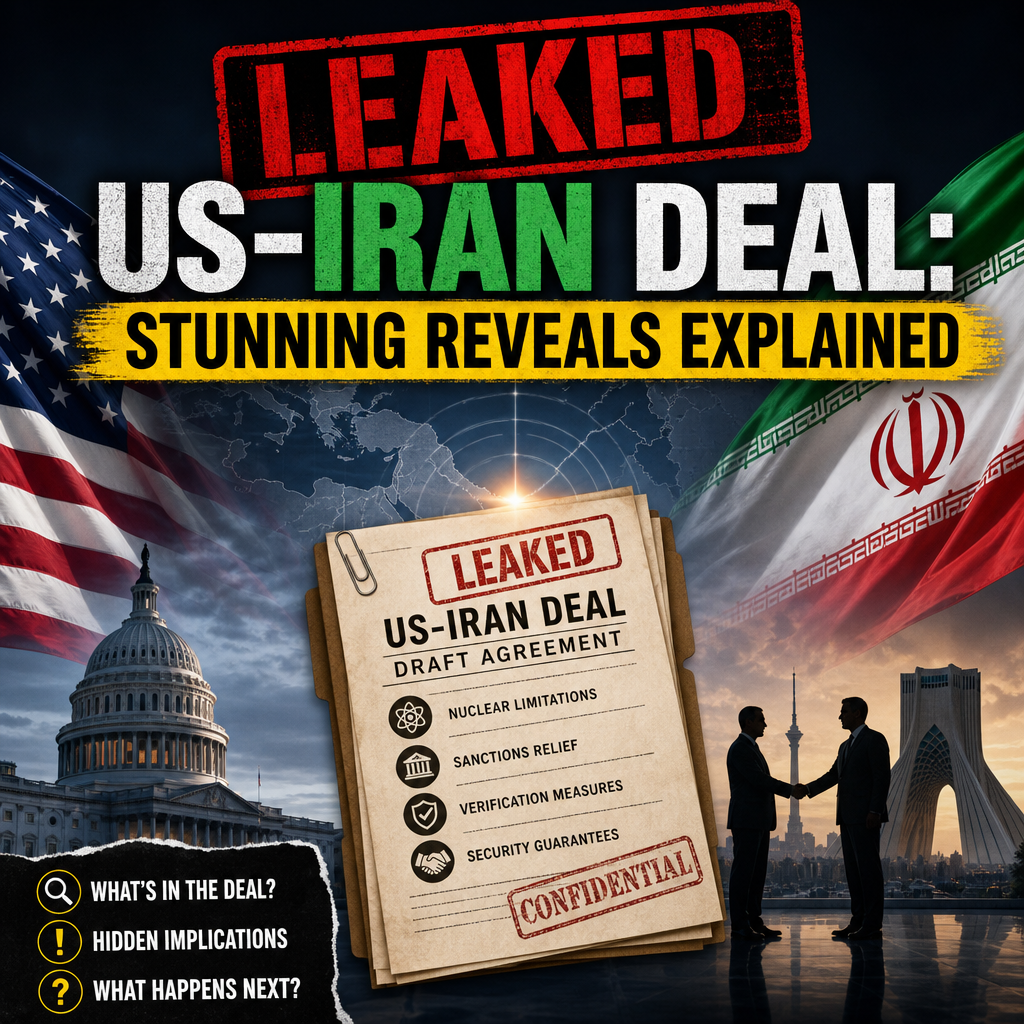
Leaked US-Iran Deal: Stunning Reveals Explained


Leaked US-Iran Deal claims have sparked fresh debate over whether Washington and Tehran are edging toward a breakthrough, or whether the story is more about political signaling than a concrete agreement.
The latest reports, circulated through outlets with very different editorial instincts, point to a familiar pattern in US-Iran diplomacy: a mix of back-channel contacts, public denials, selective leaks, and intense speculation. What makes this round of reporting stand out is not just the idea of a deal, but the suggestion that a framework may exist even as both sides continue to speak in careful, often contradictory language.



At the center of the discussion is a simple question: is a genuine diplomatic opening taking shape, or is the “leak” itself part of a larger information battle? Based on the reporting ecosystem around the story, the safest answer is that there is evidence of engagement, but not enough verified detail to conclude that a final deal is in place.
What the Leaked US-Iran Deal Reports Are Actually Suggesting
Across the coverage, the broad claim is that indirect US-Iran talks have advanced farther than many observers expected. That does not necessarily mean a formal agreement has been signed. In fact, the strongest common thread among the reports is uncertainty. The language used in the sources ranges from cautious to skeptical, and that matters.




Some accounts frame the alleged leak as proof that both sides are exploring a compromise to reduce tensions. Others suggest the story may be exaggerated, selectively sourced, or strategically timed to influence domestic audiences. That split is important because diplomacy involving Iran is rarely just about the diplomatic table. It is also about deterrence, sanctions, elections, regional alliances, and public messaging.
A few points appear consistently across the broader reporting landscape:
– There is continuing US-Iran contact, likely through intermediaries.
– Nuclear concerns remain central, even when not spelled out in every report.
– Sanctions relief, prisoner exchanges, or frozen assets are often part of the negotiation backdrop.
– Neither side has publicly confirmed a full, finalized agreement matching the more dramatic claims.
That last point is key. In stories like this, a leak can be based on real discussions without reflecting the final shape of an agreement. Sometimes it reveals a draft position, a trial balloon, or a negotiating tactic. In other cases, it may be built on outdated or partial information that has been amplified for effect.
Leaked US-Iran Deal: Why the Timing Matters
Timing is often the most revealing part of stories like these. If the leak is accurate, it may be designed to help one side prepare its domestic political base for compromise. In the US, any accommodation with Iran tends to trigger sharp criticism from hawkish lawmakers and regional allies. In Iran, any concession to Washington can be portrayed as either pragmatic statecraft or dangerous weakness, depending on who is speaking.
That makes a leak useful in at least three ways:
1. Testing public reaction
Governments sometimes allow details to seep out to gauge whether a deal is politically survivable.
2. Applying pressure
Revealing that talks are progressing can push the other side to move faster or make clearer commitments.
3. Shaping the narrative
Both Washington and Tehran have strong incentives to claim leverage, even when the actual talks are fragile.
This is where the contrast among news sources becomes relevant. Outlets like RT often emphasize the strategic and geopolitical angle, sometimes casting the US as the more manipulative actor in the exchange. Al Jazeera’s broader international coverage tends to place the story in the context of regional diplomacy, sanctions, and the human consequences of prolonged confrontation. Sky News-style reporting usually underscores the uncertainty and asks what any deal would mean for Western security, allies, and the nuclear issue. Those different lenses can produce very different headlines from similar raw facts.
What Could Be in a Real Agreement?
If there is a real negotiation advancing behind the scenes, the likely components are not mysterious. Past US-Iran contacts have revolved around a relatively narrow set of issues:
– limits on Iran’s nuclear enrichment activities
– inspection and monitoring arrangements
– sanctions relief or limited access to frozen funds
– de-escalation in regional proxy conflicts
– prisoner swaps or humanitarian concessions
The challenge is that every one of these elements is politically sensitive. Iran wants tangible relief, not vague promises. The US wants verifiable restrictions, not symbolic concessions. Meanwhile, regional players such as Israel and Gulf states often view any US-Iran understanding through a security lens, worried that a deal could reduce pressure on Tehran without fully addressing its regional influence.
That is why even a partial agreement can become controversial fast. Supporters may call it a practical way to avoid a wider crisis. Critics may argue it rewards bad behavior or weakens deterrence. Both views have merit, depending on which risk one thinks is greater: escalation or accommodation.
The Most Responsible Reading of the Leak
The most balanced conclusion is that the leak should be treated as a sign of movement, not proof of resolution. It likely reflects some combination of genuine diplomacy, strategic messaging, and media amplification. There may well be substantive talks underway. But the leap from “discussions are happening” to “a stunning deal has been reached” is much too large without independent confirmation.
That caution is especially important in US-Iran coverage, where rumors can outpace facts very quickly. A leak may accurately capture the mood of negotiations while still missing the final details. It may also be intentionally shaped to create momentum that does not yet exist. In either case, the public is left with a partial picture.
For now, the fairest assessment is this: there is enough smoke to suggest real diplomatic activity, but not enough fire to declare a finished accord. The story is less about a dramatic revelation than about the familiar, uneasy reality of US-Iran relations — a relationship where even silence can be strategic, and where every leak is as much about influence as information.

























